
Why do people show up for music?
And why do music consumers show up for you?
It’s a simple question with a surprisingly layered answer.
One I’ve been exploring across dance-floors, classrooms, studios, and far too many late-night conversations with DJs who swear, “it’s just about the music.”
It rarely is.
The Story: A Night That Explained Everything
Years ago, I watched two sets in the same venue.
The first DJ was technically brilliant – tight mixdowns, interesting track IDs, clean transitions.
But the floor didn’t move.
The second DJ came on with fewer “wow” techniques and a deceptively simple tracklist… yet by the third track the entire room was alive.
The difference wasn’t skill.
It was understanding what people needed in that moment.
Not “what sounds good,” but:
- What makes them feel safe enough to let go
- What makes them belong
- What makes them express their identity
- What helps them transcend the week they’ve had
That night became the seed for this article.
Why Maslow Matters in the Music Business
Human behaviour – especially around music consumers – follows patterns.
And one of the clearest maps we have is a psychological framework most of us met in school:
Maslow’s Hierarchy of Needs.
It outlines five levels of human needs, arranged in a pyramid from basic survival to self-actualisation:

- Physiological
- Safety
- Love & Belonging
- Esteem
- Self-Actualisation
The idea is simple: we try to satisfy lower levels before reaching higher ones.
But when you view Maslow through the lens of DJ-driven culture, nightlife, and modern music consumer needs, something interesting happens.
It stops being academic theory…
and becomes a practical tool for understanding why listeners listen, why fans follow, and why some audiences pay, willingly and repeatedly.
Many people know me as “the numbers guy.”
Those who know me better know I’m the business guy, not an accountant.
In music, numbers matter, yes!
But intent, behaviour, and value matter more.
Ask an economist, Google, or even ChatGPT, and it will tell you music lives in Level 3: Love & Belonging.
But if you’ve sat in my classes, you’ve heard me say this:
“Music lives everywhere on Maslow’s pyramid – just not where Google says it does.”
Maslow’s framework can get complex very quickly.
So let’s simplify.
Let’s reframe it specifically for DJs, producers, and anyone trying to build a real, long-term, fan-driven music consumer lead business.
Not as theory, but as a way to read a dancefloor the way a strategist reads a market.
Understanding Music Consumer Behaviour Through Maslow’s Hierarchy
A Practical Lens for DJs & Producers
Most DJs think people come to shows for music.
They don’t.
They come for needs: human, emotional, social, economic.
Music is just the vehicle.
And once you start seeing your audience through this lens, your marketing, programming, and brand strategy shift naturally.
If you approach your next gig not as a performance, but as a hierarchy of needs to fulfil, everything changes:
You select tracks differently.
You read rooms differently.
You communicate differently.
You build your brand intentionally, not reactively.
Music becomes more than sound.
It becomes a service.
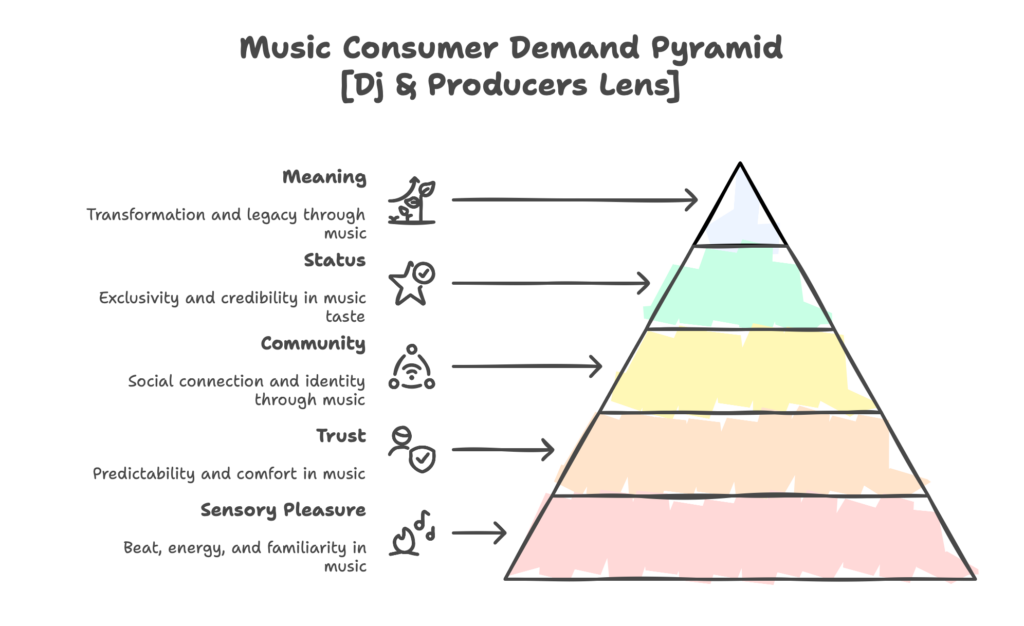
1. Physiological Needs: Music as Sensory Survival
Music meets a basic biological and emotional need for stimulation – much like food satisfies hunger.
This is the foundation layer.
A beat that hits.
A drop that releases tension.
A familiar hook that signals, “This feels good.”
This is where casual listeners live.
Their demand is driven by ease, familiarity, and instant gratification.

For DJs and producers, this stage isn’t about artistic judgement.
It’s about volume.
- Streams
- Short-form clips
- Reels that hook attention in seconds
- Trending remixes
- Dancefloor-friendly sets
This audience isn’t looking for meaning. They’re looking for sensation.
Motivation for the Music Consumer:
“Can I enjoy this experience right now?”
Reality Check for DJs
People won’t care about your tracklist if:
- Ticket prices feel unreasonable
- The venue feels suffocating
- The sound system is painful
- They’re tired, hungry, dehydrated, or overwhelmed
A DJ’s music lands only when the listener’s body feels ready.
Business lesson:
The best promoters don’t sell music.
They sell readiness for music.
2. Safety Needs: Trusting the Experience
Once people feel good, they look for predictability.
Not physical safety – emotional safety.
They return to:
- DJs who read rooms well
- Venues that feel welcoming
- Brands that feel familiar
This is why certain DJs become “go-to” names.
Not because they’re the most technical – but because they’re dependable.
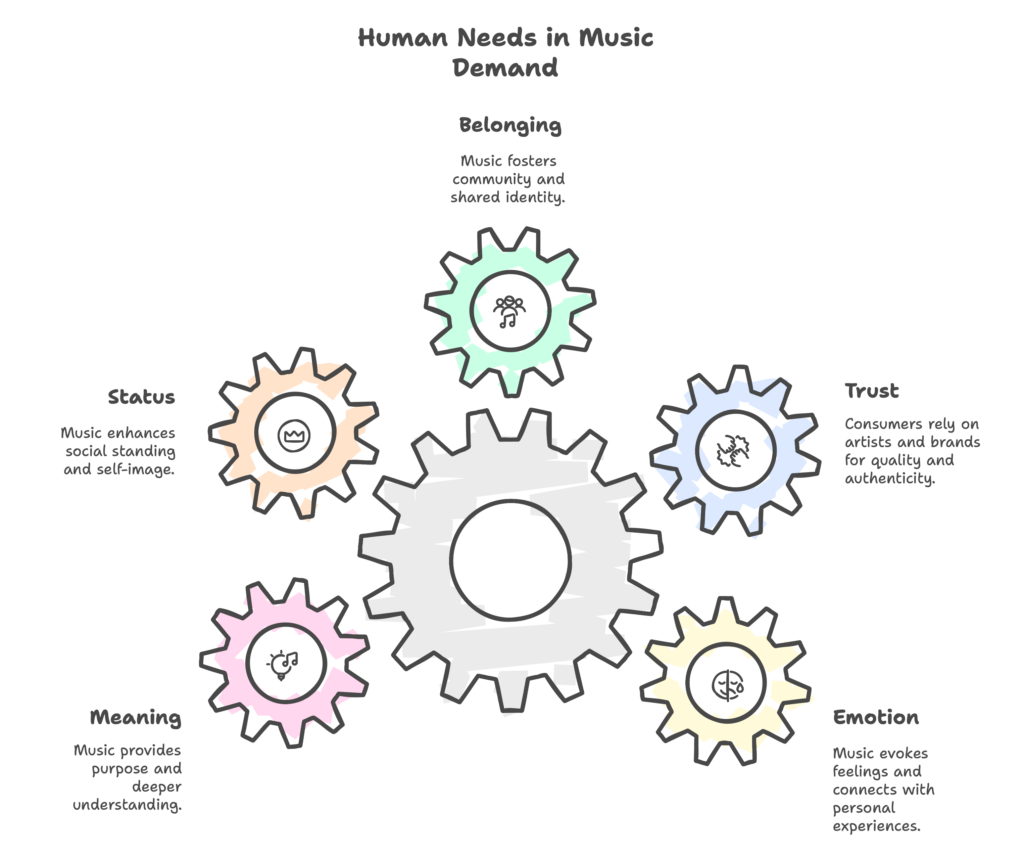
Here, consumer demand shifts from curiosity to comfort.
The shift:
“What is this?” → “I know this works for me.”
This is where branding really begins.
Not logos.
Not fonts.
But trust.
Motivation for the Music Consumer:
“Do I feel okay being myself here?”
Business lesson:
A DJ with a “safe brand” earns repeat demand.
3. Belonging: Music as Social Identity
Move one layer up and music becomes a tribe.
People don’t attend gigs just for sound.
They attend to find their people:
- Techno loyalists
- Psy families
- Afro-house heads
- Day-party crowd
Music becomes a social identity.
Fans follow artists who make them feel connected – not just to music, but to a community.
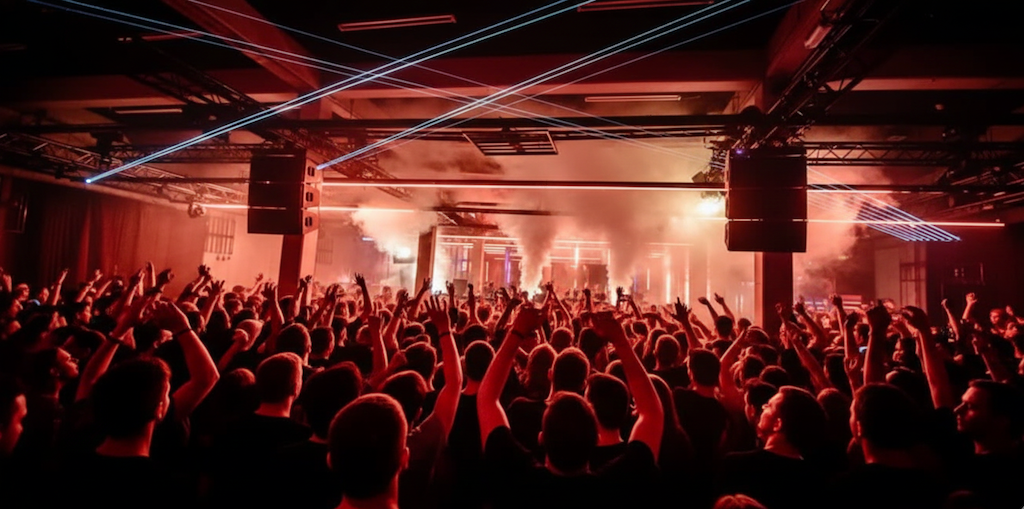
Your audience isn’t consuming sound.
They’re choosing who they are through you.
Motivation for the Music Consumer:
“Who will I be with?”
Business lesson:
If you build community, you create demand insulation.
Others compete on music.
You compete on belonging.
4. Esteem: Prestige, Taste and Status
Now motivations sharpen.
Music becomes a status signal.
Some people want to be:
- The early discoverer
- The underground supporter
- The one who “knows before everyone else”

They curate identity through taste.
Demand becomes aspirational:
- Limited shows
- Unreleased edits
- High-quality storytelling
- Credibility
- Co-signs
People at this level don’t just pay for music.
They pay for exclusivity.
Motivation for the Music Consumer:
“Does this artist reflect who I am becoming?”
Business lesson:
Artists with clear identity command premium demand.
5. Self Actualisation: Music as Meaning
At the highest level, fans aren’t consuming music.
They’re seeking transformation.
The nights we never forget.
The sets that shift something inside.
The moments that feel healing, spiritual, or liberating.

Music becomes purpose.
Fans don’t follow you for what you play.
They follow you for what you unlock inside them.
These fans aren’t consumers.
They’re advocates.
They bring friends.
They defend you.
They follow your journey.
Motivation for the Music Consumer:
“Does this experience help me grow or release?”
Business lesson:
This is where legacy forms – not through hype, but through impact.
So How Does This Help DJs and Producers?
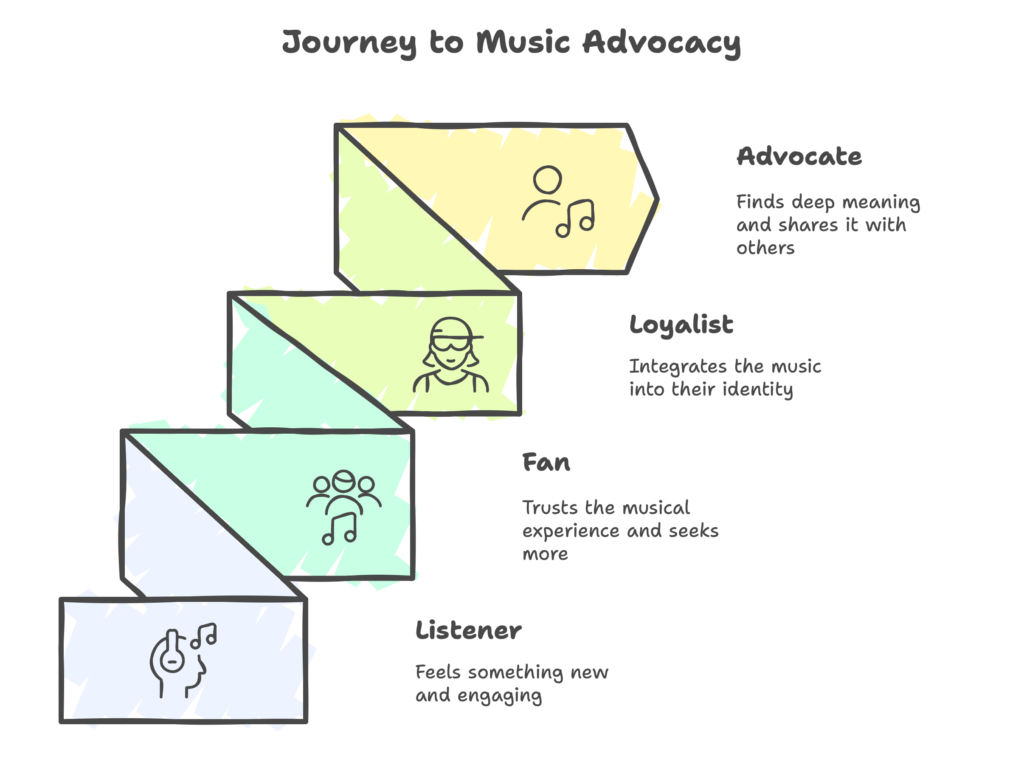
Because demand isn’t random.
There is structure beneath the chaos.
Each layer reveals what your audience is buying:
- At the base → Emotion
- In the middle → Identity
- At the top → Meaning
The real skill is understanding where your audience currently sits – and guiding them upward.
Not with louder marketing.
But with deeper alignment.
Listeners → Fans → Supporters → Advocates.
Framework Table
| Maslow Level | Music Consumer Motivation | DJ / Producer Strategy | Economic Behaviour |
| Physiological | Sensory pleasure | Accessible, catchy sound | Price-sensitive mass demand |
| Safety | Trust, predictability | Consistent delivery | Repeat behaviour |
| Belonging | Community & identity | Tribe building | Loyalty-driven demand |
| Esteem | Status & exclusivity | Premium positioning | High-margin demand |
| Self-Actualisation | Meaning & purpose | Transformative experiences | Patronage & advocacy |
A Reflection to Close
The music business often feels chaotic:
Algorithms.
Trends.
Competition.
Saturation.
But human behaviour hasn’t changed.
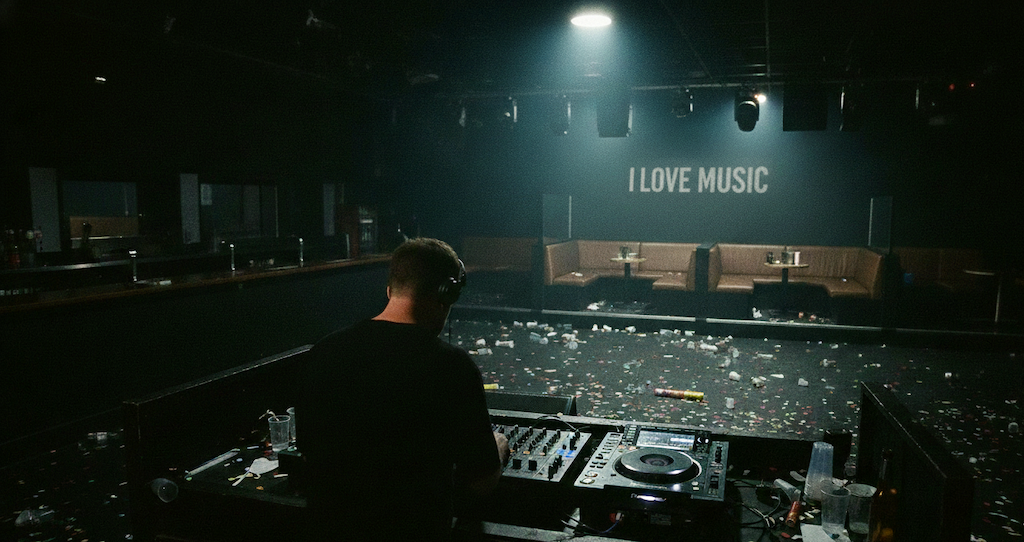
People still want to feel.
To belong.
To be seen.
To grow.
If you understand that, you understand demand.
And if you understand demand, you build a career that isn’t just heard –
but remembered.
If this shifted your perspective, share it with someone who needs it. Sometimes a new framework is all someone needs to unlock the next level.